
When Someone Devalues You, Don’t Believe Them
5 Ways Catabolic Leadership Devalues Human Beings… And How Relational Value Helps Us Rewrite the Narrative
Many of us are taught to be grateful for any opportunity. Unpaid internships gift us experience, spec work and collaborations promise exposure, passion projects provide soul fulfillment.
And while genuine gratitude for such experiences and connections can absolutely feel like payment enough, it’s important that we develop an internal barometer to keep the balance. Many of us in the workforce are wounded healers in disguise. Light-workers, galactic volunteers, perpetual givers who carry a painful karmic lesson only realized when burnout lands us in survival mode.
The balance I’m referring to in today’s reflection is not about compensation. Everyone has their own relationship with money. It’s up to each individual to discern when to donate one’s services, when to offer sliding scales, when to barter, and when to charge full price. That’s a different topic altogether.
Today’s inspiration is more about the human touch. How people are treated. And reclaiming our power when we realize we’ve been mistreated. Let’s dive in.
One way designated leaders might devalue team members is through lack of acknowledgment. When your contributions are rarely affirmed or even noticed, eventually the thought arises: “Why bother?” In Energy Leadership terms, this thought typically results in Level 1 Energy, along with feelings of apathy, helplessness, & depression. And how could it not? When patterns reveal that our efforts are insignificant in the eyes of the designated leader, how would we be expected to summon the stamina to keep showing up?
Yet, we do. And we try even harder next time, pulling all-nighters, cranking out projects, responding to requests with the highest quality deliverables in record time. Hoping this effort will finally be met with acknowledgment, appreciation, or care. But when the pattern repeats, the nervous system recoils yet again. Over time, minimization impacts self-worth. Understandably. Humans are relational beings. We are deeply impacted by environments where our care, devotion, and contributions are consistently dismissed, diminished, or picked apart.
Which brings us to our next devaluing behavior: chronic criticism. Imagine you make a tremendous effort, only to receive feedback focused solely on what you could have done differently. Nothing is celebrated. Instead, you’re blamed and antagonized, while your contributions are nitpicked with a demeaning tone. This is not constructive feedback. It’s abuse. In Energy Leadership terms, this dynamic often activates Level 2 Energy, resulting in feelings of conflict, resentment, frustration, and defensiveness. Over time, the nervous system begins bracing for interaction, anticipating disappointment rather than support. In desperate attempts to avoid feeling belittled again, we try harder. Refining. Perfecting. Overanalyzing every detail before hitting send. “Leading by example” through supportive and optimistic communication. But the pattern repeats, and our will power erodes. Because we are simply not designed to thrive in environments where our efforts are never enough.
Another way Catabolic designated leaders devalue team members is by withholding clarity while expecting excellence. Expectations remain vague. Communication is inconsistent. Priorities shift without transparency. Company values are rarely (if ever) articulated. And yet somehow, the team is still expected to deliver flawless results. In Energy Leadership terms, this dynamic often creates a pendulum swing between Level 1 and Level 2 Energy. Confusion, self-doubt, anxiety, frustration, hypervigilance. The nervous system begins burning enormous amounts of energy trying to read between the lines, anticipate needs, and avoid failure without ever being given a clear map.
This. Is. So. Exhausting.
Team members become excessively self-reliant, compensating for the absence of direction. Simple tasks begin carrying disproportionate emotional weight because the fear is no longer just “Did I do this correctly?” but “Will I be blamed for not intuiting what was never communicated?”
And this is not to say all designated leaders who exhibit ambiguity are abusive. Some are humble enough to show gratitude for the way their teams navigate uncertainty when trust and communication are present. The injury occurs when individuals are expected to perform at a high level, while simultaneously being deprived of the information, support, or clarity necessary to succeed. And then find themselves on the receiving end of the aforementioned attitude and criticism. The devaluation cycle repeats.
Over time, it’s human nature to internalize the chaos. Team members stop trusting their instincts. They assume the confusion is their fault, because subconsciously… it’s easier to internalize blame than it is to hold a Catabolic leader accountable.
And this brings us to our 4th trait of a designated leader who devalues team members: treating reliability as an expectation rather than something worthy of appreciation.
The irony is that this dynamic often emerges in environments where the designated leader himself/herself is deeply unreliable. Texts and emails go unanswered. Communication disappears altogether. Responsibilities are inconsistently upheld. Expectations change suddenly and without context. Emotional unpredictability keeps everyone walking on eggshells. And without discussion or acknowledgment, the team absorbs the impact.
Yet, someone has to hold it all together.
So the reliable people default to filling in the gaps. They compensate. They step in at the last minute. They smooth over tension. They anticipate problems before they escalate. Over-preparing, over-delivering, over-functioning, over-extending. They may even feel a nagging sense deep down that boundaries are needed, but they override those gut instincts because if they do not carry the weight, the organization as a whole might suffer.
In Energy Leadership terms, this often creates prolonged Level 2 and Level 3 patterns. Frustration. Exasperation. Hyper-responsibility. Stabilizing the environment. The reliable individual becomes trapped in cycles of doing more and more while receiving less and less support or acknowledgment in return. In fact, the Catabolic leader often grows resentful and hostile towards the reliable team members, because they can show up in ways the leader of the team hasn’t yet mastered.
And eventually, reliability stops feeling like a strength and starts feeling like a sentence.
Because what is consistently expected is rarely appreciated. The dependable team member becomes so associated with competence that their labor becomes invisible. Their flexibility becomes assumed. Their sacrifice becomes normalized. Their capacity becomes exploited.
Meanwhile, the designated leader may even begin framing the team member’s over-functioning as evidence that “everything is fine,” on a good day, or “over-stepping” on a bad day, depending on the leader’s mood. While never recognizing that the stability of the environment is being artificially maintained through the chronic self-abandonment of others.
Over time, this dynamic creates severe burnout. Not simply from the workload itself, but from the emotional loneliness of being the one who is always expected to drop everything, adapt, absorb, repair, and recover without reciprocal care, accountability, or support.
Humans are capable of immense responsibility when appreciation, reciprocity, and trust are present. But when reliability is continually extracted rather than honored, even the strongest people begin to break under the weight of being treated like infrastructure instead of human beings.
Which brings us to the 5th and perhaps deepest way designated leaders devalue team members: by making people feel replaceable instead of relationally valued.
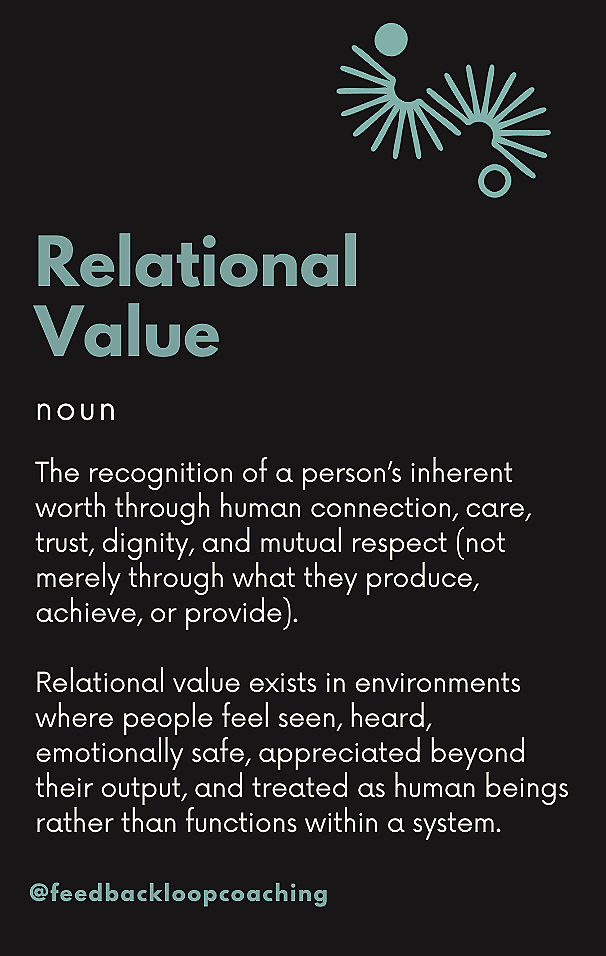
Relational value is the recognition that human beings are not disposable functions within a system, but living, breathing contributors whose humanity, perspective, wellbeing, and presence matter within the collective. Within the community. Within the organization.
And when people are treated as replaceable, the nervous system often experiences this not merely as disappointment, but as a profound rupture in belonging.
This dynamic often reveals itself the moment someone begins advocating for change. We’re taught that “the squeaky wheel gets the oil.” But in many unhealthy systems, the squeaky wheel gets replaced.
The moment someone stands up for themselves or speaks on behalf of overwhelmed teammates. The moment they name harmful patterns out loud. The moment they stop silently absorbing systemic harm and begin asking the system to become healthier.
Suddenly, the individual who was once praised for their devotion, reliability, and contributions becomes “difficult.” “Disruptive.” “Negative.” “Hard to work with.”
And perhaps most painfully, replaceable.
In many unhealthy environments, belonging is conditional upon silence. As long as the team member over-extends, self-abandons, suppresses concerns, and protects the image of the system, they are valued. But as soon as they begin reflecting truth back to leadership, the relationship changes as their honesty threatens structures built upon avoidance, hierarchy, fear, or control.
Too often, these individuals exit quietly.
And that quiet departure can feel excruciating, because there is still so much truth left unspoken. So much injustice reinforced through silence. But after months, sometimes years, of attempting to communicate, repair, and advocate for healthier dynamics, many become exhausted and depleted. By the time they are dismissed and replaced, the only justice they seek is inner peace and deep soul healing.
In energetic terms, the throat chakra frequently bears the burden of this suppression. The body learns that speaking truth leads to punishment, rejection, distortion, retaliation, or exile. So emotions are swallowed. Experiences are minimized. Silence becomes a survival strategy.
Meanwhile, false narratives often emerge in the absence of truth.
The person who challenged dysfunction may suddenly be painted as unstable, negative, ungrateful, incapable, or “not aligned with the culture.” Deception circulates. Context disappears. The system protects itself by protecting the image of leadership.
But what is rarely acknowledged is the courage it took for that individual to speak up at all.
To risk belonging in the name of integrity. To advocate not only for themselves, but for teammates who may have felt powerless to do the same. To prioritize truth over stagnation.
In Energy Leadership terms, these environments often trap individuals in chronic cycles of Level 1 and Level 2 Energy: fear, grief, suppression, resentment, conflict, and powerlessness. Over time, people begin disconnecting from their own voice in order to survive environments that punish authenticity.
Healthy leadership does not require silence to maintain loyalty.
Healthy leadership creates enough psychological safety for truth to be spoken, repair to occur, and accountability to exist without exile.
Because people are not disposable. And the individuals willing to courageously name dysfunction are often the very people attempting to protect the humanity of the entire system.
What we choose to value shapes the systems we create.
Discovering the language of “relational value” has helped illuminate something many people have felt for years but struggled to name: the difference between being valued for one’s humanity versus being valued solely for one’s utility.
And perhaps this is where deeper healing begins.
Instead of solely advocating for leaders to practice emotional intelligence, relational value empowers us to recognize and reclaim our inherent worth. We no longer wait for Catabolic leaders to transform into Anabolic leaders.
We begin reclaiming our power through self-recognition. By recognizing when environments require silence in exchange for belonging. By remembering that chronic self-abandonment is not the price we were meant to pay for acceptance.
Ultimately, what we choose to value becomes the culture we create.
And when we choose to value humanity, dignity, psychological safety, authenticity, and relational care, we begin building systems where people no longer have to abandon themselves in order to belong.
This begins with valuing yourself.
If this piece has resonated with you, there’s a chance you’ve endured the painful experience of devaluation. If so, we offer you this invitation:
Write a letter to yourself from the perspective of the most emotionally healthy, grounded, and relationally aware leader you can imagine.
A leader who truly sees people.
A leader who recognizes not only outcomes, but effort. Not only productivity, but humanity.
In this letter, acknowledge every contribution you’ve made. Every moment you supported others. Every relationship you nurtured. Every invisible task you carried. Every time you adapted, repaired, stabilized, encouraged, created, or kept going despite exhaustion.
Write about why those contributions mattered.
Write about the value of your presence, not merely your performance.
Write the words you needed to hear.
This is how we begin rewriting the narrative.
This is how we reclaim relational value from systems that benefited from our disconnection from inherent worth.
Know this: You are worthy beyond measure. Relational value is your birthright.
Continue the Practice
These reflections are an invitation. The deeper work unfolds in practice, in presence, and in relationship.
Explore Your Next Steps
Or stay connected with future reflections and offerings.
Join our newsletter