
Season’s Greetings, Radiant Being ✨
As the Sun arcs low and the Earth settles into her winter exhale, a portal of stillness opens, should we choose to accept it.
In this softened light, the veil between inner and outer worlds thins, and we gain access to the deeper patterns shaping our lives, as though we are excavating our inner caverns with only the light of a candle to illuminate our way. Because we know the darkness is nothing to fear. If it weren’t for the night sky, how would we ever know the stars?
This month, we invite you into an expanded vantage point. A perspective so objective, it almost feels alien. A dimension where cultural conditioning reveals itself, the nervous system unwinds, and presence becomes a key to the infinite now.
We have much to share with you.
Inside this issue (we know it’s long and will likely be clipped, though be sure to open it fully and scroll through it all to collect these wisdom gems):
Holiday Films Through the Lens of Energy Leadership
National Lampoon, Home Alone & The Cultural Coding of Chaos
Wealth Redistribution Begins With Us
The First-Ever Stronghold Gift Guide
Men’s Mental Health & The Weight of Holiday Expectations
Trust in the Show Up
December & Early 2026 Offerings
Holiday Coaching Gifts
Let’s explore.
As we move toward the close of the year, many are feeling the familiar swell of holiday stress. Whether it’s the pressure to hit Q4 benchmarks, attempts to uphold family traditions, or the scramble to secure gifts for everyone we love, the demand on our resources during this season of cheer historically hijacks our nervous systems.
And you know us. At Feedback Loop Coaching, any time cultural norms seem to deviate from the Tao ~the effortless, unforced flow into which everything in Nature surrenders, where actions arise from alignment rather than pressure, and life moves with ease instead of resistance~ we can’t help but wonder:
“How did we get here?”
When everything else in Nature around us is preparing for rest and hibernation, how has it come to be that we humans are pushing ourselves beyond our capacity?
Lately we’ve been reflecting on some of our earliest pop-culture influences associated with this holy time of year.
Join us as we examine: Planes, Trains & Automobiles, National Lampoon’s Christmas Vacation, and Home Alone.
While these movies may feel lighthearted, they also shape our collective imagination around the holidays. Through comedy and exaggerated mishaps, they model a version of the season defined by rushing, tension, and emotional reactivity.
And because we watched these films in some of our most formative years, curled up with family, sharing a bowl of popcorn, absorbing the humor and storylines without question, we internalized their coding as default tendencies. They trained our subconscious to associate the holidays with hectic schedules, family pressure, financial strain, and last-minute chaos. Wrapped in humor, the stress looked normal. Funny even.
But when we laugh off our own dysregulation, how accurate is our awareness and objective evaluation of these patterns?
How are these influential Hollywood blockbusters really serving our Feedback Loops?
Let’s start with the Thanksgiving classic, Planes, Trains, & Automobiles.
As the trailer narrates, “During holiday travel, some people get delirious, some get delayed, and some get Del Griffith…” we already know we’re in for a turbulent ride.
Delays, cancellations, annoying strangers, misunderstandings, panicked problem-solving, claustrophobic misery, traumatic highway visuals, and total meltdowns normalize the belief that holiday travel is chaotic, frantic, and exhausting.
And to our delight, we watch as Steve Martin’s character completely unravels, culminating in an infamous, obscenity-laced rant, fueled by mounting reactivity, escalating frustration, and explosive tantrums.
Though when I view such scenes now, through the lens of Energy Leadership, all I see is Catabolic Energy.
And it raises an important question: what happens when a culture learns to celebrate reactivity rather than cultivate calm responsiveness?
In laughing at these meltdowns, we unintentionally reinforce the belief that losing control is a reasonable response to unmet expectations… and that those on the receiving end of our frustration, often customer service employees simply doing their best within broken systems, are suitable outlets for our outbursts. When this becomes normalized, we stop objectively evaluating the impact of our behavior and instead slip into patterns that disconnect us from our own humanity and the humanity of others.
Which invites the question: how are such models of behavior, transmitted through entertainment, really serving us?
And more importantly: what might be the ideal energetic template for a holiday centered around such an essential frequency as Gratitude?
National Lampoon’s Christmas Vacation: The Burden of Inherited Expectations.
Next up, we examine National Lampoon’s Christmas Vacation, a film that has become a cultural staple for its slapstick, situational, and satirical comedy. Though we also see it as a portrayal of how our own unregulated stress can spill outward and create problems for everyone around us. Even when our intentions are pure, the default behavior of overextending ourselves in the name of tradition actually results in harm.
Clark Griswold is, in many ways, the archetype of Level 2 holiday energy: fueled by an obsessive need to recreate the perfect Christmas, he manifests tunnel vision for himself. His intense attachment to outcomes narrows his perception, contracting his awareness so much that any potential empathy for neighbors Todd and Margo dissolves.
What makes their dynamic especially striking is that Todd and Margo aren’t actively meddling. They’re simply living their lives next door. They mind their own business, maintain their own rhythm, and make no attempt to interfere. Yet Clark’s escalating chaos spills into their world again and again, shattering their peace, damaging their property, and pulling them into a storyline they never opted into.
Some see Todd and Margo as the antagonists to Clark’s protagonist. We don’t. We see them as neutral, grounded, self-contained individuals who are unfortunately influenced by someone operating from unmitigated catabolic energy. Confusion, defensiveness, and the strained attempt to maintain boundaries amid someone else’s unraveling are all understandable behaviors. Yet, we’ve been conditioned to perceive them as the villains. What might be the subconscious result of such programming? Perhaps we develop distorted Feedback Loops, normalizing reactivity while pathologizing neutrality. When we confuse chaos for charm and boundaries for hostility, how likely are we to feel confident in setting our own healthy boundaries?
As for Clark, the gap between his expectations and the reality attracts all sorts of conflict. As viewers, we may laugh at his misfortune, likely because we see parts of ourselves in the familiar narrative:
The belief that love must be proven and earned through performance. That joy is acquired through material abundance.
That family harmony depends on our ability to tolerate (Level 3 Energy) our way through dysfunction. As Clark says, “Christmas is about resolving differences and seeing through the petty problems of family life.”
We understand why Clark goes to such extreme lengths. Over-planning, over-decorating, over-promising, and over-identifying with a fantasy that no human nervous system could reasonably uphold. His fixation becomes a pressure cooker, and the more he clings to the expectation of perfection, the more catastrophic the breakdown becomes.
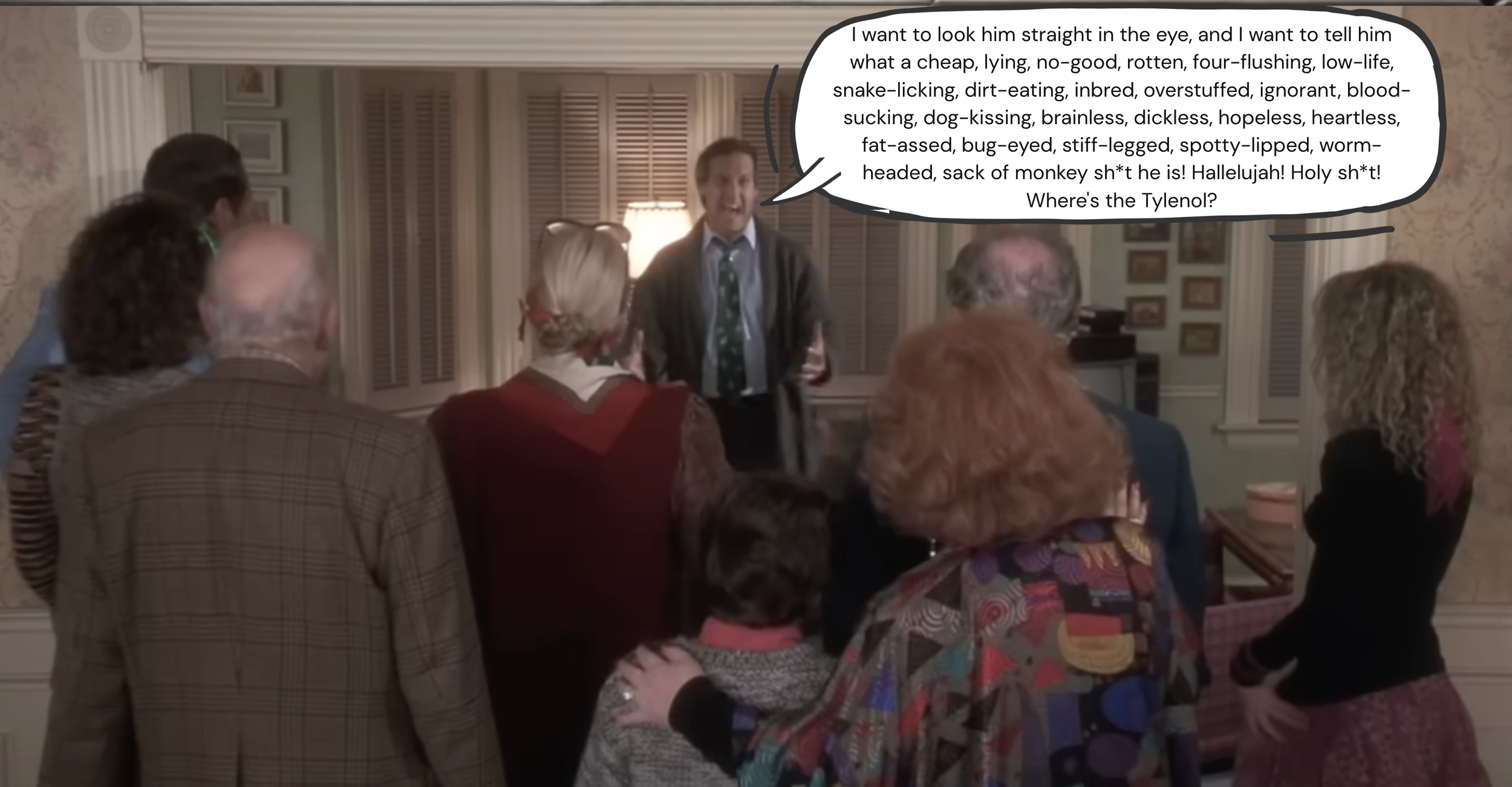
From the blinding Christmas lights to the disastrous family dinner to the exploding tree, the message encoded in the comedy is pervasive enough to take note:
Chaos ensues when attachment to the outcome eclipses our ability to be present in the moment.
When viewed through the lens of Energy Leadership, Clark embodies the slippery slope from Level 3 justification (“It’ll all work out, because I am in control”) to Level 2 anger (“Why can’t anything go right?!”) to the full-on catabolic eruption in the final act.
And once again, we laugh.
Because we’ve been there. We’ve inherited the same scripts:
→ That holiday chaos is normal.
→ That disappointment is inevitable.
→ That doing more is the way to guarantee connection.
→ That alcohol is a solution to our problems, as in one of the final scenes meant to touch our hearts, Clark seeks wisdom from his father asking, “All our holidays were always such a mess. How did you get through it?” To which his father replies, “I had a lot of help from Jack Daniels.” Again, we are meant to laugh, though these days we can’t help but raise a discerning eyebrow. How funny is that really? What if his father had said, “I remained grateful and present with the people I love.”
→ And that we can force someone into having a change of heart, a false message reinforced when the most potent wisdom of the movie is delivered by Clark’s boss only after he’s been kidnapped and compelled to confront the repercussions of canceling bonuses.
Though as we see throughout the entire movie, forcing outcomes pulls us out of harmony. Flow is found when we release our grip and open our receptive hearts into presence.
So we ask:
What would the holidays feel like if we unhooked from the cultural narrative that love requires spectacle?
What would Christmas look like if we were to transform all the pressure into ease, flow, and surrender to Nature?
How would it feel if we all truly believed that presence is the present?
Next, we saved the most traumatic movie for last: Home Alone.
Home Alone: The Myth of the “Brave Kid,” and the Cost of Forced Independence.
For nearly two decades, Home Alone was my favorite Christmas movie. It was familiar, quotable, exciting, and the symphonic music throughout the film would sweep me off my feet and into a world of wonder and adrenaline. And of course the fantasy of a child outsmarting dangerous adults felt empowering when I was a kid.
Then one day in college, during a heated debate centered around the best Christmas movie, a housemate referred to Home Alone as “murder porn.” Suddenly, the spell broke. My rose-colored glasses dematerialized, and the movie transformed from a childhood classic into a dark imprint within our collective Feedback Loop.
Another decade later, as my healing journey led to inner child reconciliation, I inevitably developed heightened sensitivity to the early emotional landscapes of kids and their porous, impressionable nervous systems. I felt attuned to 8-year-old Kevin, feeling the impact of trauma hitting his cells with each moment of injustice enacted through his family’s behaviors and attitudes toward him. The kid just wanted a slice of cheese pizza! How was no one advocating for him?
Kevin wasn’t empowered. He was emotionally & psychologically neglected, then abandoned. And his family wasn’t quirky like Del Griffith or chaotic like Clark Griswold. They were abusive.
They shamed, dismissed, scapegoated him and banished him to the attic. A space often associated with dust, cobwebs, isolation, confinement, claustrophobia, memories, and objects and artifacts deemed unworthy of being seen, relegated to the land of the forgotten.
When he reveals his vulnerability, pleading with his mom, “It’s scary up there,” she gaslights him with, “don’t be silly.”
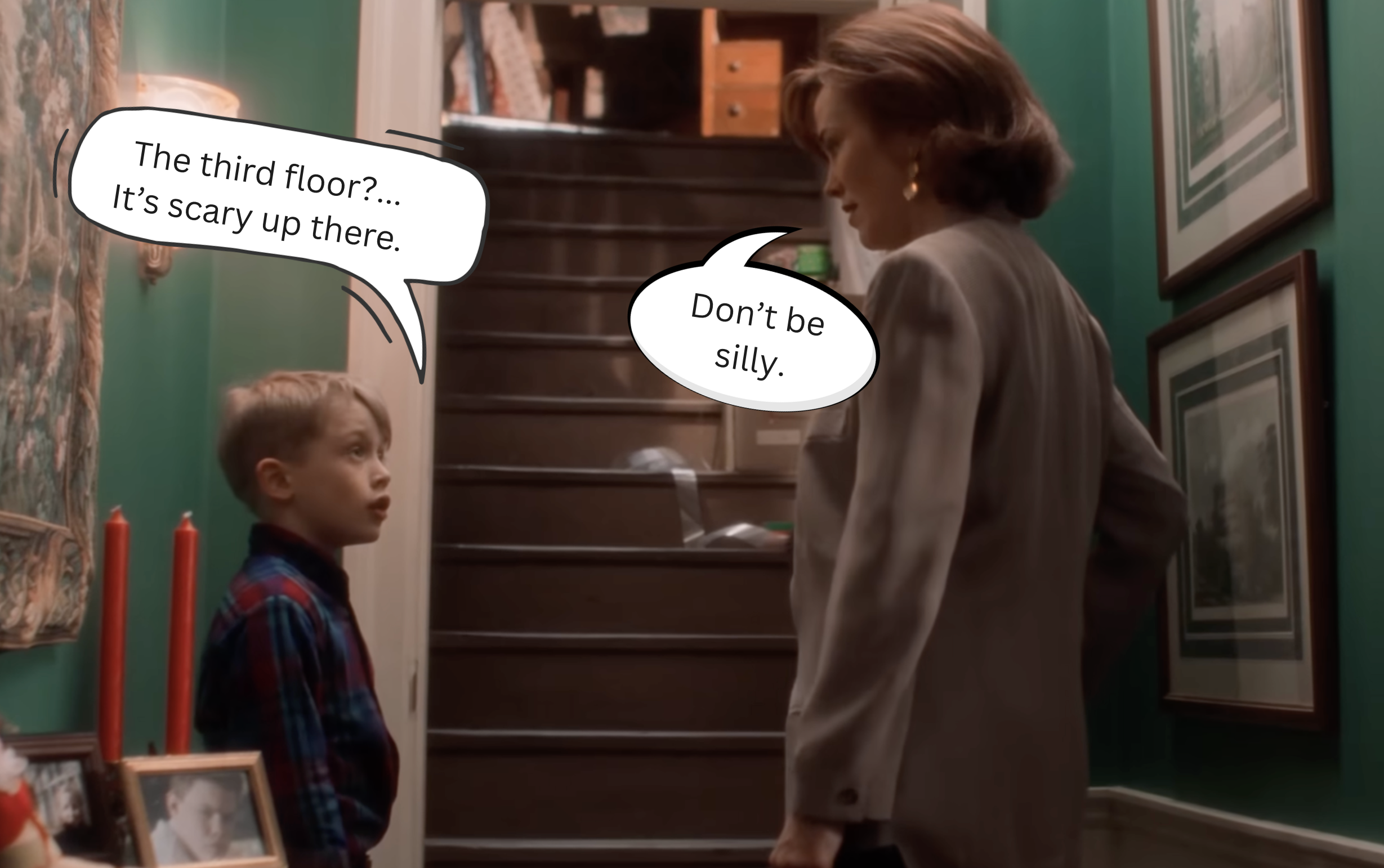
And just like the old boxes stowed away in the least frequented part of the home, he too was forgotten.
If that entire opening sequence isn’t disturbing enough, our hearts continue to break when we realize how quickly Kevin adapts to his new situation. Believing he made his family disappear, we watch his hyper-independence deepen. And we are not surprised by his resilience, as our subconscious understands more than we realize about the interplays between scapegoats, golden children, and the survival roles children absorb when care is unpredictable, inconsistent, or unsafe.
Such hyper-independence is glamorized throughout the film, as the entire plot revolves around Kevin’s ingenuity. A clever child rising to the occasion, mastering his environment, defeating danger with wit and resourcefulness all seems triumphant on the surface. Though as adults along our own healing journeys, we now see that we were cheering for a trauma-induced coping mechanism.
Kevin’s bravery isn’t a result of empowerment. It’s the culmination of his family stripping his world of all safety, losing faith in adults, and having no alternative but to rely entirely on himself. He masks fear with capability, vulnerability with responsibility, and confusion with confidence. His planning, his traps, his young swagger may have fooled us into thinking he’s a tough kid who can handle all the threats and violence that follow, but underneath the extreme competence lives a nervous system in overdrive. He’s just a little boy bracing against a world in which as far as he knows, no one is coming to save him.
What makes this movie so fascinating as we reflect in hindsight is how it reveals what the Tao refers to as “the acquired mind.” Home Alone would not have achieved such success in entertaining us had we not already developed the neural pathways normalizing hyper-independence, self-abandonment, emotional suppression, and of course holiday chaos. Kevin serves as a mirror for the way we were all taught to handle everything on our own, that asking for help is unsafe, that vulnerability is met with dismissal, and that trauma formed through family dysfunction is normal.
But what if it wasn’t?
What if we had all grown up with calm gentle adults in safe, predictable environments? What if, when we expressed emotions as children, the adults around us validated our experience? How would such a movie land?
Our hypothesis is that we would have rejected it immediately, feeling repelled by the family’s mistreatment of Kevin within the first 15 minutes.
Because a regulated nervous system does not find entertainment in the suffering of a child.
A heart attuned to safety does not mistake trauma for triumph.
A culture rooted in tenderness and connection does not glamorize forced independence as empowerment.
If these films reveal anything, it’s how deeply our culture has deviated from the natural rhythms of the season. While Nature withdraws, softens, and restores, we accelerate. While the Earth quiets, we escalate. While winter invites reflection, we reenact cycles of pressure, performance, and perpetuated chaos. Perhaps because these narratives were handed to us before we were old enough to question them.
Which is why we hit the sacred pause button Now to apply our three core concepts:
Awareness, Evaluation, & Choice.
We have illuminated the patterns with the bright light of Awareness, evaluated their encoding with objectivity, and now we stand in the moment of true agency: we get to choose.
Choose whether we embody the inherited scripts of stress, overextension, and self-abandonment…
Or soften into a new way of being. One that aligns with Nature, honors our nervous systems, and returns us to presence.
Because once we see the architecture of the old conditioning, we’re no longer bound to it.
Awareness disrupts the script.
Evaluation clears distortion.
Choice reveals the path of liberation.
This is where the practice moves from the internal to the collective.
If the holidays are a mirror for where our culture has drifted out of harmony, they’re also an invitation to return. Not just in how we self-regulate, but in how we participate in community, exchange energy, and circulate resources.
Which brings us to one of the most powerful forms of aligned action we have access to:
Wealth redistribution.
Wealth Redistribution Begins With Us.
In our ideal world, we’d all embody the “health is wealth” mantra, giving ourselves and each other gifts that support wellness, rest, nurturing, and compassion. Quality time with family would be the gift. Gratitude for warmth during the winter would be the currency.
Though we’re not there yet. We are still wired for material exchange.
So perhaps this Holy Days Season, we make a statement by rebelling against the consumption-mania programmed into our Feedback Loops.
Maybe we vote with our dollars, feeling the autonomy and sovereignty in every purchase, recirculating economic vitality in a way that inspires the kind of world we want to build.
Instead of funneling money toward big corporations and designer labels, this is the moment to uplift the crafters, makers, healers, and creatives in our immediate orbit. We all have friends whose offerings carry soul and intention ~art, herbal blends, jewelry, books, coaching, mentorship, movement practices, handcrafted gifts.
Redistribution doesn’t only happen from the top down. In fact, the popular call for billionaires to “save the world” is one of the most disempowering narratives of our time. When we place responsibility in the hands of the ultra-wealthy or in political machinery, we reinforce the belief that we are powerless.
We’re not.
We are powerful beyond measure.
And we get to exercise our power by coming together as one and rising like a mighty wave.
A wave that inspires change through community coherence, and by getting real about all the energy we offer to what we believe is public service.
Every year, billions of dollars flow into political campaigns (resources spent on persuasion rather than true service) while community support systems remain underfunded.
Imagine if communities instead pooled resources to invest in people: their ideas, mental health, creativity, resilience, and small businesses. Imagine if instead of funding political campaigns or consumerist demand, we invested in each other.
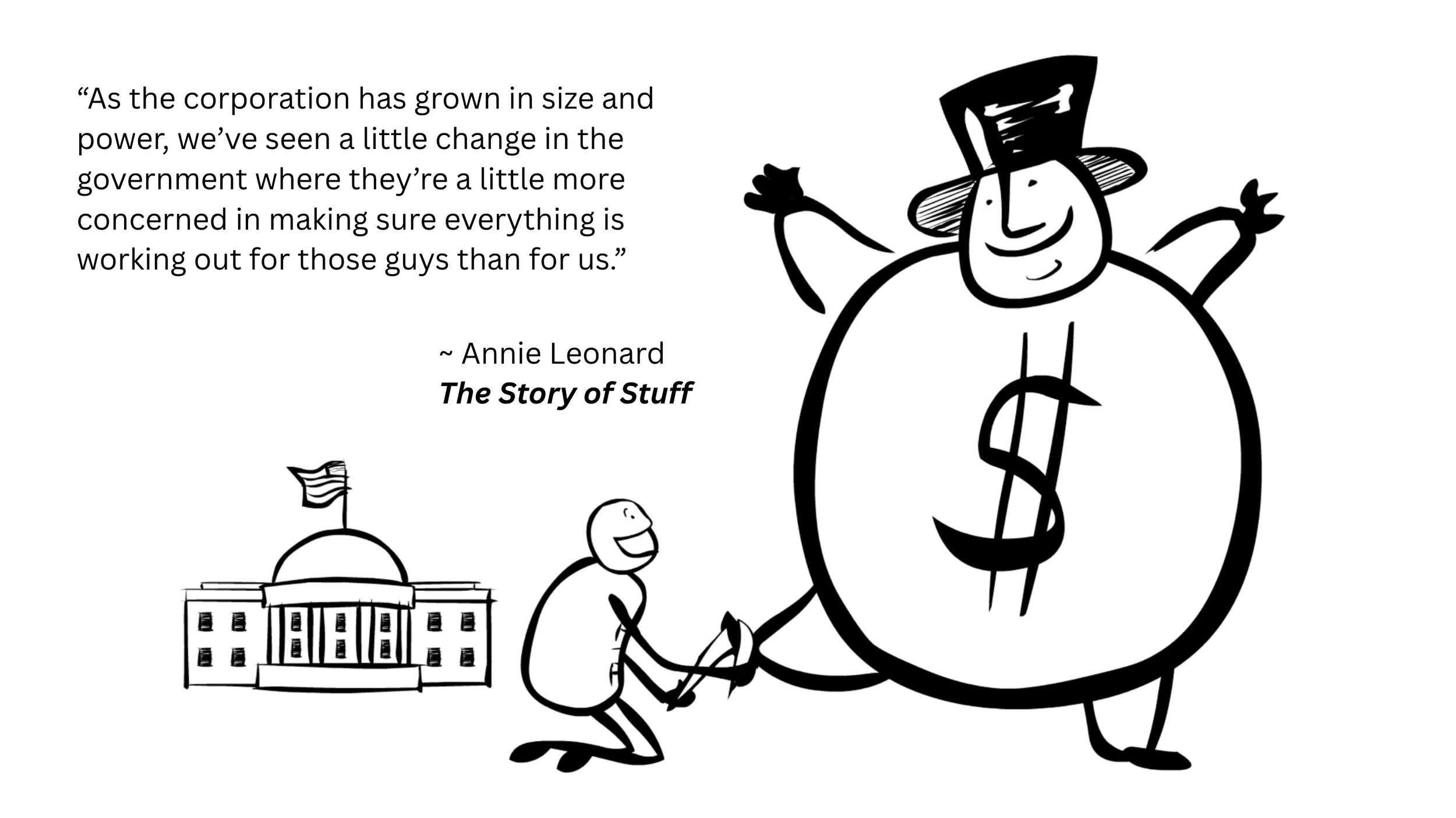
I am reminded again of The Story of Stuff. As filmmaker and activist Annie Leonard explained back in 2009:
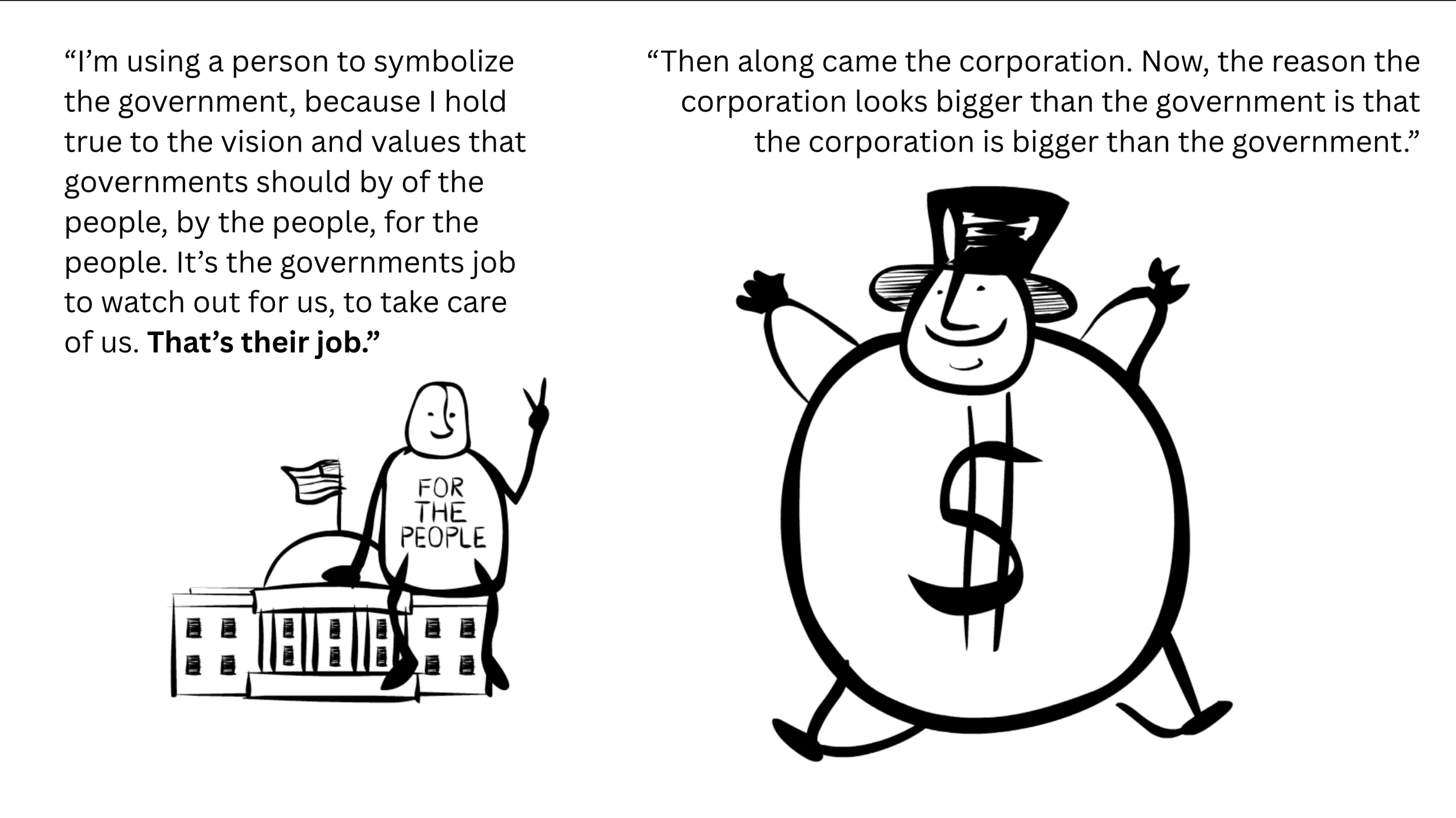
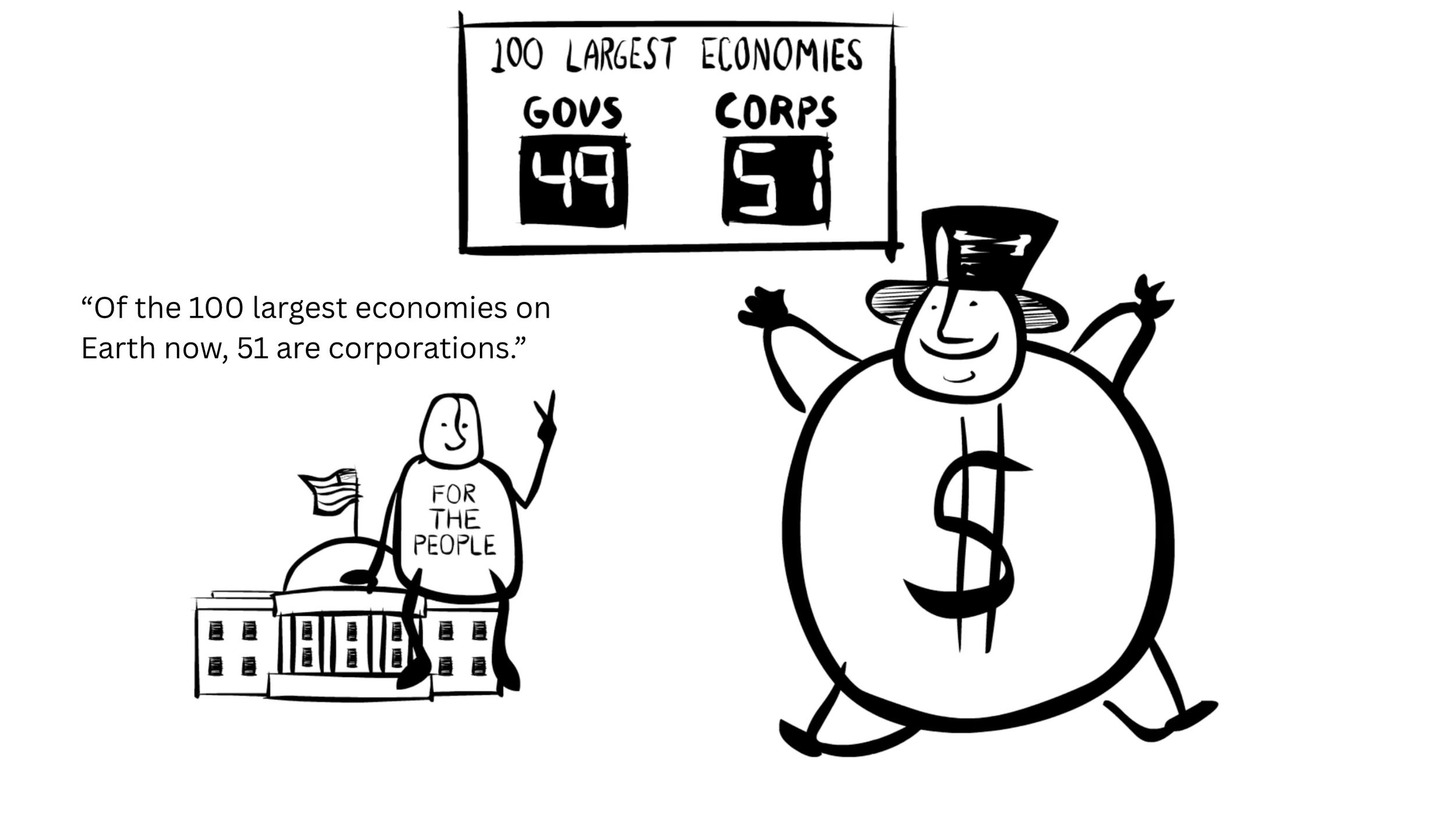
“Now my friends tell me I should use a tank to symbolize the government, and that’s true in many countries and increasingly our own. After all, more than 50% of our federal tax money is now going to the military. But I’m using a person to symbolize the government, because I hold true to the vision and values that governments should be of the people, by the people, for the people. It’s the government’s job to watch out for us, to take care of us. That’s their job. Then along came the corporation. Now, the reason the corporation looks bigger than the government is that the corporation is bigger than the government. Of the 100 largest economies on Earth now, 51 are corporations. As the corporation has grown in size and power, we’ve seen a little change in the government, where they’re a little more concerned in making sure everything is working out for those guys than for us.”
Considering this critique was created in 2009, the natural question becomes:
What has changed 16 years later?
Have these patterns reversed or self-perpetuated?
If you guessed “self-perpetuated,” you are correct. Here’s what we’ve observed:
1. Corporate Wealth & Influence Have Intensified
In 2009, 51 of the 100 largest economic entities were corporations.
Today, as many as two-thirds are.
Examples of this multiplication effect:
Tech giants (Apple, Amazon, Meta, Microsoft) each surpass the GDP of most nations.
Corporations now influence global supply chains, data privacy, communication platforms, labor conditions, and political advertising.
Corporate lobbying has increased—over $4 billion annually in the U.S. alone, with Big Pharma, Big Tech, and finance dominating.
2. Government–Corporate Interdependence Has Deepened
Leonard warned that governments were increasingly concerned with keeping corporations happy.
Since then, the relationship has fused.
Governments now rely on corporations for:
technological infrastructure
transportation and logistics
pharmaceuticals and medical equipment
defense contracting
clean-energy transition
social-media communication platforms
In moments of crisis, governments turn to corporations for solutions.
The line between the public and private sectors is no longer clear. They function as a single ecosystem.
3. Consumerism Has Accelerated, Not Slowed
Despite rising awareness of sustainability, global resource extraction has skyrocketed.
Fast fashion exploded (Shein, Fashion Nova, Zara, Primark).
Planned obsolescence evolved into software obsolescence (devices rendered “old” through updates).
E-commerce scaled convenience while ballooning waste streams.
We buy more, discard more, and stress the planet more than ever before.
4. The Attention Economy Became the New Frontier
In 2009, social media was still young.
Today, attention is:
the primary commodity
the mechanism through which behavior is shaped
the psychological layer where desire is manufactured
the nervous-system hook that keeps consumption looping
Corporate tentacles now extend directly into:
dopamine cycles
self-worth
identity formation
worldview
relational patterns
This is the part no one foresaw when welcoming the 4th Industrial Revolution into our daily lives:
Corporations competing for our perception, our focus, our inner world.
And this is where we step in.
This is where the revolution of the people, by the people, for the people begins.
By reclaiming our attention.
By reclaiming our agency, as well as our access to knowledge. By returning to the basics of critical thinking: Who, What, Where, When, Why, and How… we begin to dissolve the unconscious loops that shape our choices. This can be as simple as researching the corporations we purchase from, or gently sharing what we’ve learned with the people we love.
We have countless opportunities to educate through connection rather than correction.
For example, when Chris’ nephew expressed his desire to obtain a pair of Nike sneakers, Chris offered a brief lesson on sweatshop labor and subcontracted factory practices. His nephew still chose the Nikes, but now, at least, he chose with awareness.
And that’s all we are advocating for right now: that we the people are equipped with the bigger picture, so our decisions, whatever they may be, are made from an informed, empowered place.
This is how we begin to slow the acceleration outlined above.
By interrupting the supply-and-demand machine.
When we demand slow fashion, fair labor, high quality, and responsible extraction, the supply will shift.
The machine won’t course-correct on its own.
Otherwise it would have by now.
From a linear system of
extraction → production → distribution → consumption → disposal
to a circular, reciprocal, life-honoring, closed-loop where resources are respected, regeneration is prioritized, and the flow becomes:
reverence → creation → circulation → regeneration → renewal.
A system rooted in stewardship, coherence, and wisdom. Think it sounds too idealistic and not realistic? Think again…
The Private Sector, ladies & gentlemen. May we list for you…
Companies Already Embodying Circular, Regenerative, Closed-Loop Systems:
· KAKAO Drinking Chocolate — honoring Indigenous wisdom, supporting regenerative farming, and centering reciprocity in every step of the supply chain.
· Patagonia — pioneering repair culture, circular design, and community reinvestment.
· Eileen Fisher — demonstrating how fashion becomes regenerative through renewal, reuse, and intentional simplicity.
· Purusha People — creating clothing infused with intention, handcrafted in small batches using natural fibers, ethical labor, and zero-waste practices. Their work honors body, Earth, and spirit through a slow-fashion model rooted in reverence. (And the founder Hayley graduated from Simsbury High School with my brother Mike.)
· Allbirds — creating carbon-conscious footwear rooted in natural and renewable materials.
· Avocado Mattress — modeling carbon-negative production through organic, regenerative agriculture.
· Dr. Bronner’s — weaving social justice, regenerative farming, and ethical commerce into a single ecosystem.
· Who Gives A Crap — turning everyday essentials into a force for global sanitation and sustainability.
· SOKO — empowering artisans with fair wages and circular materials through ethical tech.
· Reformation — a brand proving that beauty and sustainability not only coexist, but thrive together.
· Vivant Vintage — A Boston-based vintage clothing shop that embodies circular fashion. By curating secondhand and upcycled pieces, Vivant interrupts the fast-fashion cycle entirely, extending garment life, reducing textile waste, and offering style rooted in history, sustainability, and soul. They prove that shopping can be creative, ethical, and regenerative all at once.
And here’s the best part: it’s founded, owned, and operated by our dear friends Emmy & Justin, who have navigated one heck of a year. So… truly, shop there. Support them.
(Real talk: Emmy has been my sister in entrepreneurship for the past 8 years, inspiring me to keep going when my mind & body wanted to quit and re-enter stable corporate life. As I embark on my new money story ~from broke entrepreneur to wealthy community leader~ I am so excited to recirculate funds through Emmy’s silver jewelry collections. Knowing my Coven sister travels the country hand-selecting each piece infuses an extra layer of meaning into every item. I’m already dreaming of my next trip to Boston.)
These companies prove the point:
Circularity isn’t idealism. It’s already happening.
And it’s actually the private sector, not public, listening to the hearts of the people. Awakening to the demand for regenerative business. Synthesizing our hopes and requests into useful products.
It’s just up to us to choose them. In doing so, we throw a wrench in the old paradigm machine.
This is how an empowered civilization evolves.
And this is where we, the Worcester Stronghold, come in.
If we want a new economic story, we don’t just talk about it. We practice it. We keep wealth circulating in our circles, our neighborhoods, our creative ecosystems.
As we like to say, in the Stronghold family.
Keeping the dollar in the family.
With that in mind, here are some offerings from within our own community. Businesses infused with intention, integrity, and soul. These aren’t big corporations. They’re humans. Friends. Creators. Visionaries. People whose work nourishes the collective.
Below are a few who contribute their time & energy by showing up to the Stronghold. It’s our honor to present the first ever Stronghold Gift Guide, spotlighting the small businesses that nourish the roots of this Central Massachusetts family.
✨ Stronghold Gift Guide: Businesses That Embody Circularity, Craft, and Conscious Exchange:
• Sam’s Stems — Ethical Flowers, Arranged With Heart
Sam’s Stems brings reverence back to floral artistry. Through locally sourced blooms, seasonal arrangements, and mindful design, Sam creates pieces that honor the Earth rather than extract from it. Her bouquets feel like small ecosystems: tender, intentional, and alive. A beautiful alternative to mass-produced florals and a meaningful way to gift beauty with integrity.
• Awen & Co — Inspired Branding Rooted in Collaboration
Awen & Co is a design collective built on intuition, artistry, and deep human partnership. Founder Stephanie Audette Connor and her gifted team help businesses bloom from the inside out, crafting brand identities that are strategic, soulful, and visually magnetic. Their work has uplifted hundreds of small businesses across New England and beyond, proving that creativity, collaboration, and integrity are still the foundations of great design.
• Adriana Keefe — Intuitive Human Design & Embodied Mentorship
Adriana brings Human Design to life through intuitive readings, 1:1 mentorship, group containers, and her no-BS approach to energetic alignment. Her work helps people decondition from old narratives, reclaim their natural expression, and navigate life with clarity and confidence. A powerful gift for anyone seeking direction, permission, or energetic truth.
• The Domesticated Wild Child — Herbalism for the Whole Family, Rooted in Integrity & Ancestral Wisdom
Created by Corinn, The Domesticated Wild Child is a small-batch herbal apothecary dedicated to whole-plant medicine and family wellness. From baby balms to therapeutic infusions, every product is crafted with organic, sustainable, ethically wild-harvested ingredients. No parabens, no phthalates, no GMOs — just pure, intentional, earth-honoring remedies. This is herbalism as devotion, and a beautiful way to nourish your people while supporting a mother, maker, and healer doing soulful work.
• WanderKnots Macrame — Fiber Art With Spirit & Story
WanderKnots Macramé is the handcrafted work of Brittany, a devoted mother of two girls whose artistry transforms ordinary cord into soulful, tactile beauty. Her creations, plant hangers, wall pieces, yoga straps, and home décor, infuse spaces with warmth and intention. If you’ve admired my macramé yoga strap or the pothos hanger at Mati Yoga Studio, you’ve already experienced her magick. Perfect for gifting artistry made by a creatrix weaving care into every knot.
• Mati Yoga Studio — Movement, Mindfulness & Community
Mati Yoga Studio in Millbury, MA offers a welcoming, heart-centered space for all bodies and levels. With heated and mellow flows, restorative classes, kettlebell training, Cacao Circles, and a wide variety of workshops, Mati blends modern movement with the timeless principles of breath, awareness, and presence. Students describe it as vibrant, grounding, and deeply supportive. A temple where transformation becomes accessible. A true gem of the Worcester area.
Your Invitation
If any of these offerings call to your heart, reach out to these small businesses directly. Place an order, book a service, or inquire about gift cards for the loved ones in your orbit.
Every intentional exchange keeps the dollar in the family and strengthens the Stronghold we are building together.
From Community Support to Men’s Mental Health: A Necessary Shift in Awareness
As we redirect our resources toward community, circulating our dollars with intention, uplifting small businesses, and strengthening the Stronghold, we’re reminded of another truth:
Community isn’t only built through commerce. It’s built through emotional safety, shared responsibility, and the courage to tend to the parts of ourselves that have long gone unspoken.
And this is especially true for men.
If the holiday films we explored earlier reveal anything, it is the quiet emotional burdens men have been taught to carry alone. Clark Griswold, for instance, is often portrayed as comedic, lovable, and a bit off the rails, but beneath the slapstick is a portrait of a man collapsed under the weight of unspoken expectations.
Clark internalizes:
the pressure to provide
the pressure to keep everyone happy
the pressure to “make Christmas perfect”
the pressure to hold it all together without asking for help
He becomes the archetype of what happens when a man swallows his needs, ignores his limits, and believes his worth is tied to performance.
We laugh at his outbursts, but many men live versions of this privately, without the comedic soundtrack.
Holiday expectations intensify the mental load men carry:
providing, planning, performing, fixing, absorbing, enduring.
And because many men were socialized to stay silent, numb out, or self-isolate, their nervous systems often reach breaking points.
The data confirms what we’re witnessing energetically:
Nearly 80% of suicide deaths in the U.S. are men.
Men are four times more likely to die by suicide, yet half as likely to seek mental-health support.
Only 17% of men receive mental-health services in a given year, despite widespread stress, burnout, anxiety, and emotional overload.
Many men also enter midlife with shrinking social circles, reporting fewer close friendships and more isolation, one of the strongest predictors of mental-health decline.
Because boys are taught from a young age to “toughen up,” “shake it off,” or avoid appearing weak, emotional expression becomes a foreign language many men never learned to speak.
And beyond emotional load, biological shifts also amplify the strain on men:
Over the past several decades, average testosterone levels in men have steadily declined, even when comparing men of the same age across generations.
One large, multi-decade meta-analysis of healthy men found a significant drop in mean total testosterone over roughly 55 years, a decline that cannot be fully explained by aging alone.
The decrease is not limited to older men: recent data show that adolescent and young adult men also exhibited lower testosterone between 1999 and 2016 compared to prior decades, even among those with normal body weight.
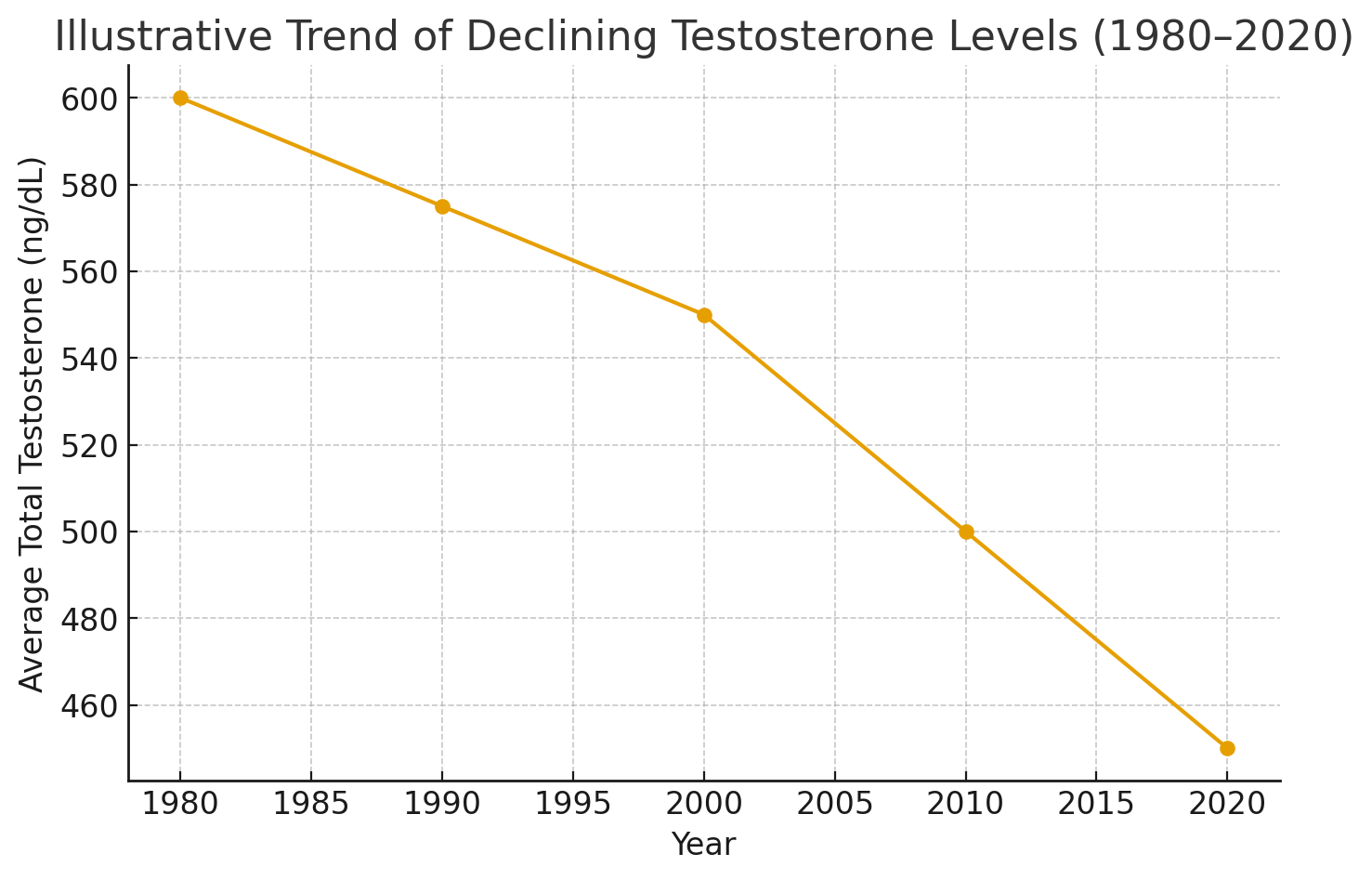
*Data based on MMAS, NHANES (1999–2016), and global meta-analyses tracking generational declines in male testosterone. Trend line reflects composite findings across these studies.
In our November Newsletter, we went ahead and connected the dots between decreasing testosterone levels and the mental health crisis among men, though we want to reiterate the importance of this link, because research shows that many clinicians do not routinely screen for hormonal or endocrine factors like testosterone before diagnosing or prescribing medication for depression or anxiety. This means a significant number of men placed on antidepressants or anti-anxiety medications may never have had their hormone levels evaluated at all.
We are calling on both men and women to advocate for comprehensive hormonal screening before being placed on powerful SSRIs. These pharmaceuticals often treat the symptom, but the cause (whether hormonal imbalance, thyroid disruption, chronic inflammation, trauma patterns, or sleep disturbances) remains untouched.
As Phish sings, “If you can heal the symptoms but not affect the cause, it’s quite a bit like trying to heal a gunshot wound with gauze.”
We are entering a new paradigm. One that elevates the root causes of health, invites community conversations about what truly works, and honors bio-individuality. For some, Heart & Soil may be transformative; for others, Moon Juice may nourish what’s depleted; for others still, ION Gut Support may address the very foundations (Chris & I have tried them all).
This is the chapter of listening inward, attuning to what each body needs, and restoring balance between the masculine and feminine within and around us. In this era:
strength includes softness
resilience includes rest
leadership includes vulnerability
support is not a luxury, but a necessity
Which brings us to something Chris has quietly, steadily been building…
The Brotherhood Circle
Chris here, and what a few months it has been. Teaching college courses has challenged me in immeasurable ways and has also revealed something important about the inner experience of being a man today. While I maintain the awareness that depression affects millions of men every year, and many never seek help, I hadn’t reflected that knowledge inward since my spinal fusion recovery. Though at the start of the semester, as I stepped into the classroom, I began to notice how quickly negative inner dialogue can take hold, especially in moments of uncertainty or pressure. And how such an inner dialogue can spiral into hopelessness when not properly acknowledged.
My own inner gremlin, whom I call Lord Sidius, tends to appear whenever a student looks confused, upset, or disengaged. I am grateful for the tools that coaching has given me, because they help me see how the language we use internally can create unnecessary stress and tension. Each time Lord Sidius whispered that I was not good enough, or when I felt that familiar tightness in my chest as a frustrated student stared back at me, I took a breath and returned to the truth: if I were not meant to be here, I simply would not be.
Doing this deeper mental and emotional work has also brought me back into my physical practices. Recently, I have felt re-inspired by weight training. When I first began my body weight-shedding journey, the gym became a sanctuary and eventually led me toward becoming a Certified Personal Trainer while healing my lower back. Even then, long before my awakening, I could feel how lifting weights created mental clarity and helped me engage more fully with life.
As men, it is essential that we show up for ourselves in ways that are healthy and regenerative so that we can also show up for the world as strong protectors and providers. In a society that often encourages us to retreat into phones, laptops, gambling, and other distractions, connecting with the physical body is more important than ever.
Rachel and I learned from our teacher Jesse when we were in Japan the importance of balancing Practice with Theory, while being mindful not to merge them.
Life asks us to engage with life.
Whether through working out or physical labor, our bodies teach us presence. We are designed to stand tall and proud, and at the same time there must be room within the heart for vulnerability, emotion, and the courage to ask for help.
It is from this place that a men’s group has been quietly forming within me. It has been years since I was part of a brotherhood circle in Boston, and I have felt the absence of that space. This group will offer a place to explore theory together, and then embody it through physical practice, strengthening the body and building real, lasting change.
For now, I am committed to taking a Kettlebell Class at Mati Yoga Studio on Monday nights at 5:45 p.m.
Then on Tuesday, December 23, we will gather at Root Awakening in Worcester to share in discussion, connect, and get to know one another for our first official Brotherhood Circle gathering. It’s free to join. The only action for you is to simply show up.
If this resonates, and you feel ready to commit to your own growth, email me and we will walk this path together.
Hope to see you there. Email: chris@feedbackloopcoaching.com
PS. In several Pacific Island traditions, kava was a ceremonial drink shared among male warriors to cultivate calm, connection, and clarity before entering challenging moments. It was a way of settling the nervous system together, shoulder to shoulder, in a space of respect and grounded strength.
This new men’s group is springing forth from that same spirit. We look to such indigenous civilizations, because the United States is still an infant relative to other countries. We as men don’t know which ancient systems of knowledge to root into. Though we can feel the rush of the wild when we see a war cry such as the Maori Haka Dance, more widely known thanks to the New Zealand rugby team. Something awakens within our veins when we see such masculine ferocity paired with emotional devotion, a reminder that strength and spirit were never meant to be separate.
It’s our birthright as men to access that same feeling of raw electricity moving through us, as if an ancient memory rises from the bones and says, “This is how you were designed to stand.” We might not have a similar tradition yet in this country, but we are creating one. Together. We are the next generation of warriors.
This brotherhood work is a reminder that the healthy masculine within each of us is the archetype of clarity, steadiness, and follow-through. It is the part of us that chooses, commits, and shows up, even when the outcome is uncertain. The balanced masculine energy generates willpower, discipline, and direction. It is the inner structure that allows our creativity, intuition, and feminine flow to take shape.
And with so many soulpreneurs reaching out to us lately with doubts about their offerings or disappointment about turnout, we feel called to share a teaching that has carried us through every season of uncertainty:
Trust in the Show-Up.
Trust in the Show-Up
Recently, several fellow soulpreneurs have reached out to us feeling discouraged about their creative ideas or the turnout for their offerings. First, we want to thank you for your trust. We have both been anchoring our visions into spaces for years. Rachel has been sharing Cacao in community since 2018, long before most people even knew what it was. Chris began offering yoga and meditation around that time, usually for free, simply because the work called to him.
We followed the inner impulse because we are passionate about wellness, and we answer the call wherever it leads us. We are fortunate now to have a studio like Mati to call home, though it was not always this way. There were times when we felt deeply discouraged. Times when spaces failed to support the work, because they neglected to care for the environment, overbooked, double-scheduled, or treated our offerings as an afterthought. And there were many times when no one showed up at all.
And we never gave up.
So that we can be here now to remind you: don’t give up either.
If this is your calling, keep going. The Universe may simply be testing you the way it tested us. Sometimes it wants to be sure that we are committed to our mission even when the world appears quiet.
This is where Trust in the Show-Up becomes a practice.
Trust in the Show-Up means choosing a date, choosing a place, preparing your offering, and then releasing every expectation about who comes or what unfolds. This is what the Law of Being calls detached involvement: giving your full devotion to the creation, while letting go of the outcome.
If this feels difficult, remember the story Chris learned during his Vipassana retreat:
S. N. Goenka, who brought the practice to the United States and opened the first Vipassana centers, taught that even if no one showed up to sit, the facilitator still should.
Because one person anchoring the practice is enough.
One person holding the frequency is enough.
It is like building a lighthouse and switching on the light. At first, no ships may appear. No one may see the glow. But the signal is traveling farther than you think. Your vibration is calling the aligned people toward you. The ones who are meant to walk along your path, learn from you, or collaborate with you.
So trust in the show-up.
Every time you do, the universe rearranges itself a little more around your devotion.
And now for our December offerings and a sneaky peek into January
December Offerings~
Here’s what’s unfolding this month in our community:
🌀 The Art of Circle — December 14 with Rachel
A guided experience in heart-centered community practice.
🏛️ Small Business Stronghold — December 16 with Feedback Loop Coaching (Third Tuesday of the Month)
A space to learn, share, and fortify your business with clarity, community, and inspired action.
☀️ 108 Sun Salutations — December 20 with Chris
A cleansing, devotional practice to close the year.
🤝 Brotherhood Circle — December 23 with Chris
A grounded gathering for men seeking strength, vulnerability, support, and truth.
Coming January 2026
The Winter Warmer at Mati Yoga Studio —January 4th
A full-day pay-what-you-can retreat filled with offerings by the Mati staff, including Cacao & Sound, Heated Flow, Restorative, and more.
We’re also expanding offerings to deepen community connection and support:
Coffee with the Coaches at Cake Shop — Monthly
An open space to ask questions, seek guidance, or simply bask in optimistic vibes.Boundaried Compassion Workshop Series with Rachel
A structured, empowering journey for empaths and caregivers ready to reclaim their energy with love and clarity.Professionals Nights at Root Awakening with Chris
Community-building for leaders, entrepreneurs, and visionaries.The Atlas Circle — Launching Soon
For those who feel they are holding the weight of the world on their shoulders. You don’t have to hold it alone.
🎁 Holiday Coaching Gifts
We’ve received questions about gifting coaching to loved ones. We love the idea when a person is genuinely all-in. Coaching is a partnership. It only works when someone is ready to step into their own transformation.
If that’s the case for your loved one, we’re here for it. If not, we honor the truth that the work has to be authentic for it to be meaningful.
✨ Holiday Specials
Available through the New Year:
15% off ELI Assessments & Debriefs
15% off ELI Milestone Debriefs
As We Close 2025
This is a season of remembering that we are not separate from the world we want to build.
We are co-creators of the future, through our choices, our dollars, our presence, our circles, our courage, and our willingness to show up even when the path is still forming under our feet.
Thank you for being part of this community.
Thank you for the resonance, the trust, and the shared devotion to a kinder world.
Our wish for you this season: May you grant yourself the grace to slow down, breathe deeper, and let the stress that is not yours fall away.
May you choose ease where there was once pressure, presence where there was once performance, and truth where there was once silence.
And may you trust that every time you show up; for your work, your community, your body, your heart; you are rewiring your world.
Here’s to rising rooted, together.
— Rachel & Chris